

Wheeled Excavator
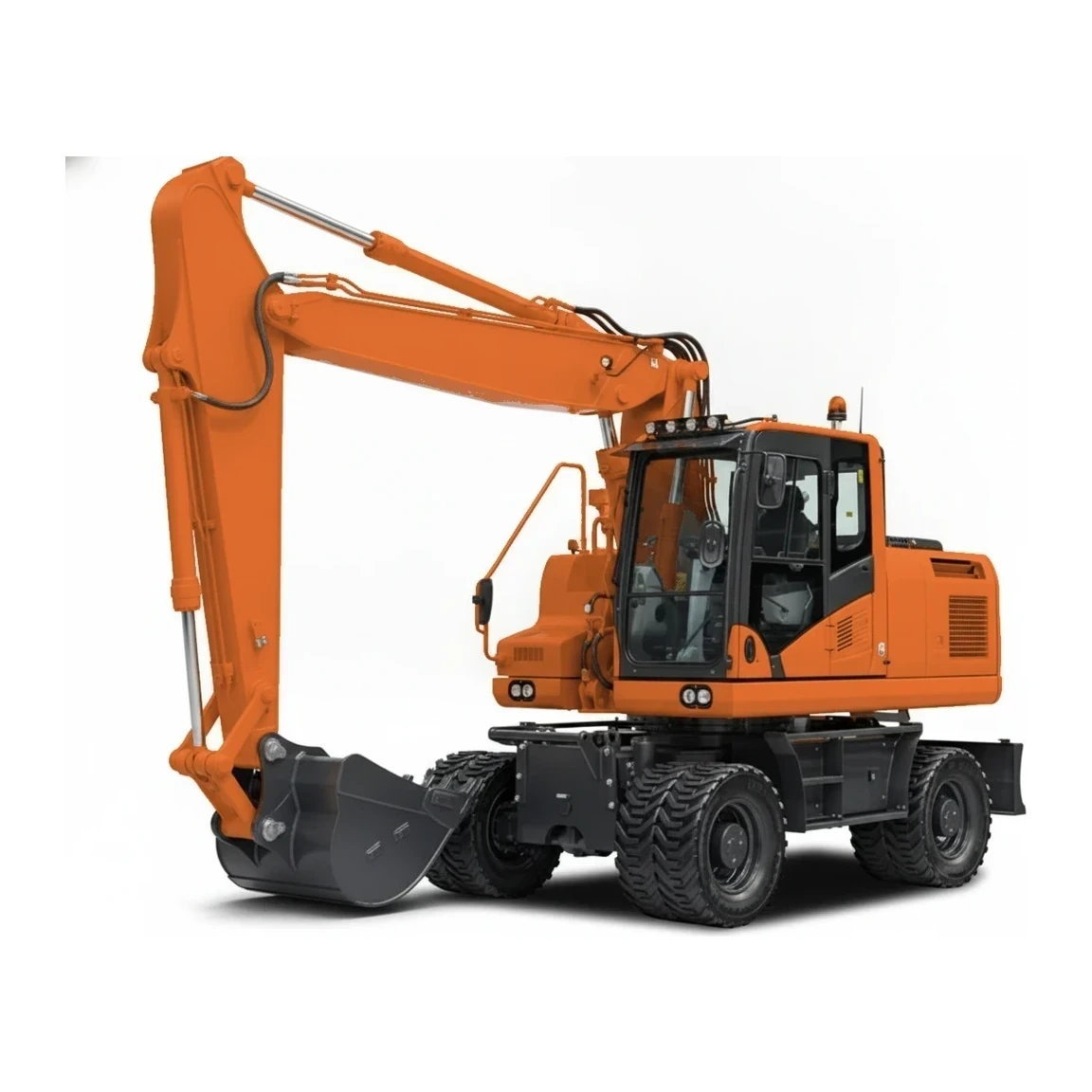
A wheeled excavator is a slewing excavator mounted on a rubber-tired chassis instead of crawler tracks. It performs standard excavator digging and lifting work while traveling between work areas under its own power at road-capable speeds, making it the excavator of choice for urban, roadway and multi-site utility work.
Cat classes
Choisissez une classe de taille : la capacité et la portée varient selon la gamme.
Fonctionnement
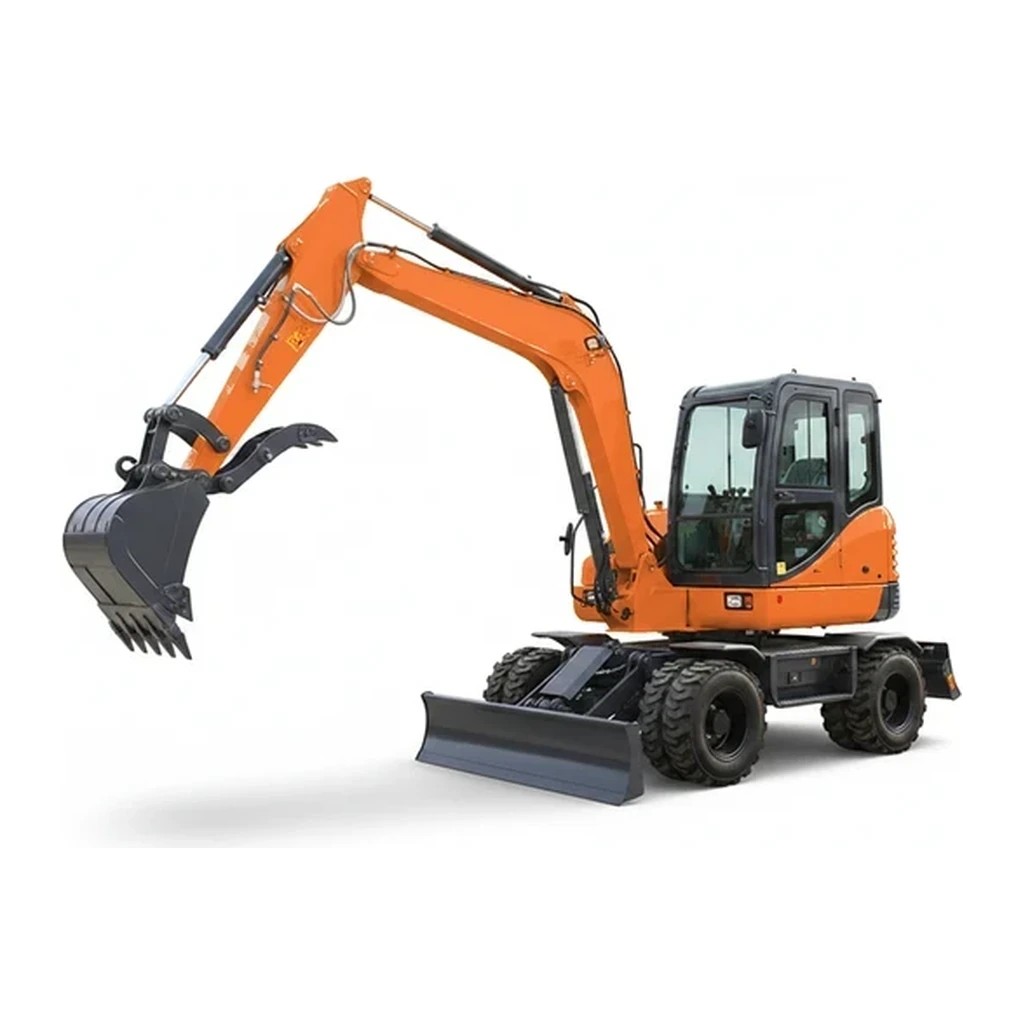
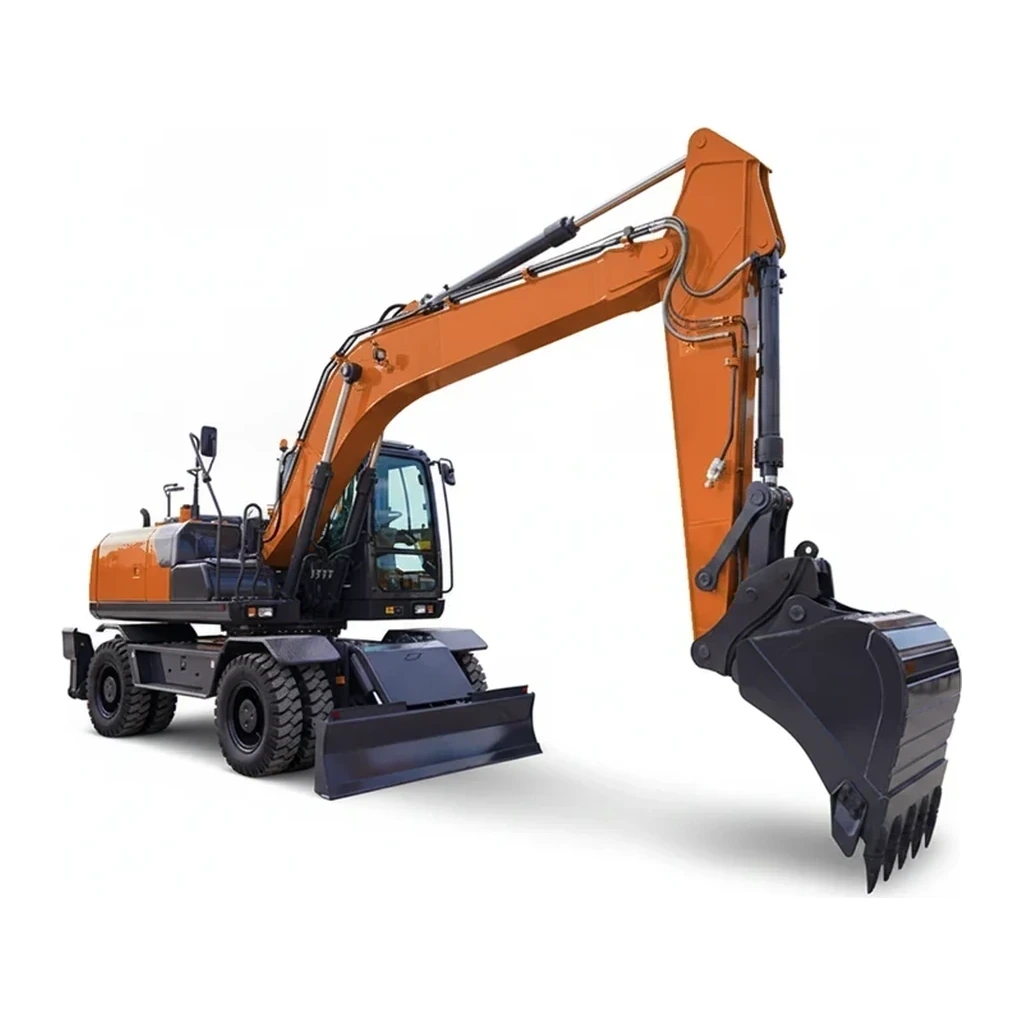
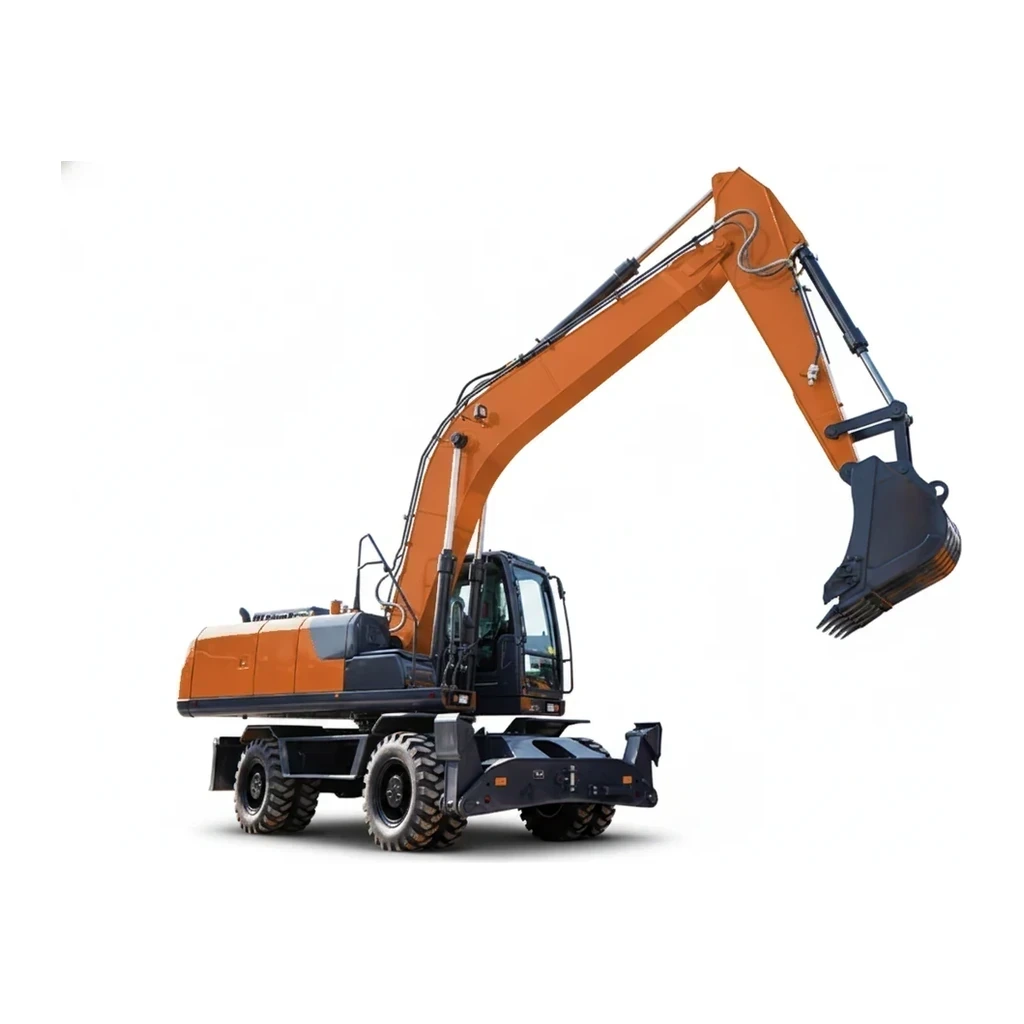
The upperstructure, engine, hydraulics, cab, boom and stick, operates like any hydraulic excavator, with pumps feeding boom, stick and bucket cylinders plus a swing motor. The difference is below the slew ring: a two-axle wheeled chassis with a hydrostatic or powershift travel drive, steering axle, and service brakes suitable for road travel. Because tires provide a less stable digging base than tracks, wheeled excavators dig with stabilizers and/or a dozer blade lowered to the ground, converting the chassis into a rigid platform. Many use a two-piece articulated boom that tucks the front in tightly for travel and for working in confined street corridors.
Types et variantes
- Mono-boom machine
- Conventional one-piece boom, the simpler and lighter configuration.
- Two-piece boom machine
- Articulated boom that shortens the travel envelope and improves close-in work along streets and structures.
- Compact / reduced tail swing
- Short-radius house for working inside a single closed traffic lane.
- Blade-and-outrigger configurations
- Combinations of front blade and rear stabilizers (or four-point outriggers) chosen for the stability the digging duty requires.
Spécifications clés
| Spécification | Plage typique | Signification |
|---|---|---|
| Operating weight | 13,007–51,641 lb (5,900–23,424 kg) | The class bands at up to 30,000 lb, 30,000-45,000 lb, and 45,000+ lb. |
| Engine power | 56.3-181.0 hp | Covers both the hydraulic circuit and road-speed travel drive. |
| Maximum dig depth | 12.8–19.9 ft (3.9–6.1 m) | Comparable to similar-weight tracked machines. |
| Maximum reach | 25–32.9 ft (7.6–10.0 m) | Working envelope at ground line, sufficient for trenching across a road lane from the shoulder. |
Comment l'industrie le dimensionne
Wheeled excavators are sized by operating weight in pounds. Compact machines up to 30,000 lb drive themselves between work points on pavement without a trailer for urban utility and municipal repair. The 30,000-45,000 lb band covers road crew machines that work off the shoulder and move down the job under their own power. Machines 45,000 lb and above handle highway maintenance, rail work and material handling with long stabilized reach. Selection weighs digging envelope against travel: all machines in the class reposition on rubber without a trailer, so the sizing question is usually the largest machine that still fits the street corridor and axle-load limits of the work area.
Applications
- Urban utility trenching and repair along active streets
- Roadway and highway maintenance requiring frequent repositioning
- Storm and sanitary work where the machine travels between scattered dig sites
- Lifting and pipe placement using stabilizer-supported load charts
- Ditch cleaning and shoulder grading on road networks
- Work on finished surfaces where crawler tracks would cause damage
Sécurité et opération
- Always dig with the blade and/or stabilizers set; tire flex without support degrades both stability and lift capacity.
- Use the correct load chart for the support configuration: capacities differ between blade-down, stabilizer-down and tires-only conditions.
- Apply the swing brake and axle lock before working; an unlocked oscillating axle changes the tipping line mid-lift.
- Follow roadway work-zone traffic control (MUTCD) when operating in live traffic: the class's defining exposure.
- Confirm local road-travel rules; lighting, brakes and speed capability vary by model and jurisdiction.
Normes et certifications
- OSHA · 29 CFR 1926.602
- Earthmoving equipment requirements on construction sites.
- ISO · ISO 10567
- Rated lift capacity method used for the multiple support-condition load charts.
- EPA · Tier 4 Final (40 CFR Part 1039)
- Nonroad diesel emissions rules for current-production engines.
- FHWA · MUTCD
- Work-zone traffic control practice governing the street environments where these machines predominantly work.
Questions fréquentes
Why choose a wheeled excavator over a tracked one?
Is a wheeled excavator as stable as a tracked machine?
Can these machines legally drive on public roads?
What sizes does the class cover?
Comparer les modèles populaires
Chercher par spécification →Normalisé aux mêmes unités. Un tiret signifie que la valeur n'a pas été publiée.
| Modèle | Poids en service | Profondeur d’excavation max | Portée max | Puissance moteur |
|---|---|---|---|---|
| Wacker Neuson EW65 | 19,063 lb (8,647 kg) | 12.8 ft (3.9 m) | - | 56 hp |
| JCB Hydradig 110W | 24,361 lb (11,050 kg) | 14.5 ft (4.4 m) | - | 109 hp |
| Hitachi ZX135W-7 | 35,053 lb (15,900 kg) | 16.1 ft (4.9 m) | 27.8 ft (8.5 m) | 141 hp |
| Hitachi ZX150W-7 | 37,920 lb (17,200 kg) | 18.1 ft (5.5 m) | 29.1 ft (8.9 m) | 141 hp |
| Hitachi ZX155W-7 | 38,801 lb (17,600 kg) | 18.9 ft (5.8 m) | 30.9 ft (9.4 m) | 141 hp |
| Hitachi ZX175W-7 | 40,786 lb (18,500 kg) | 18.9 ft (5.8 m) | 30.9 ft (9.4 m) | 141 hp |
Équipements connexes
Parcourir par fabricant
Sources
Chaque spécification est vérifiée par rapport aux données publiées par le fabricant, avec la source liée pour référence.