Slide Rail System
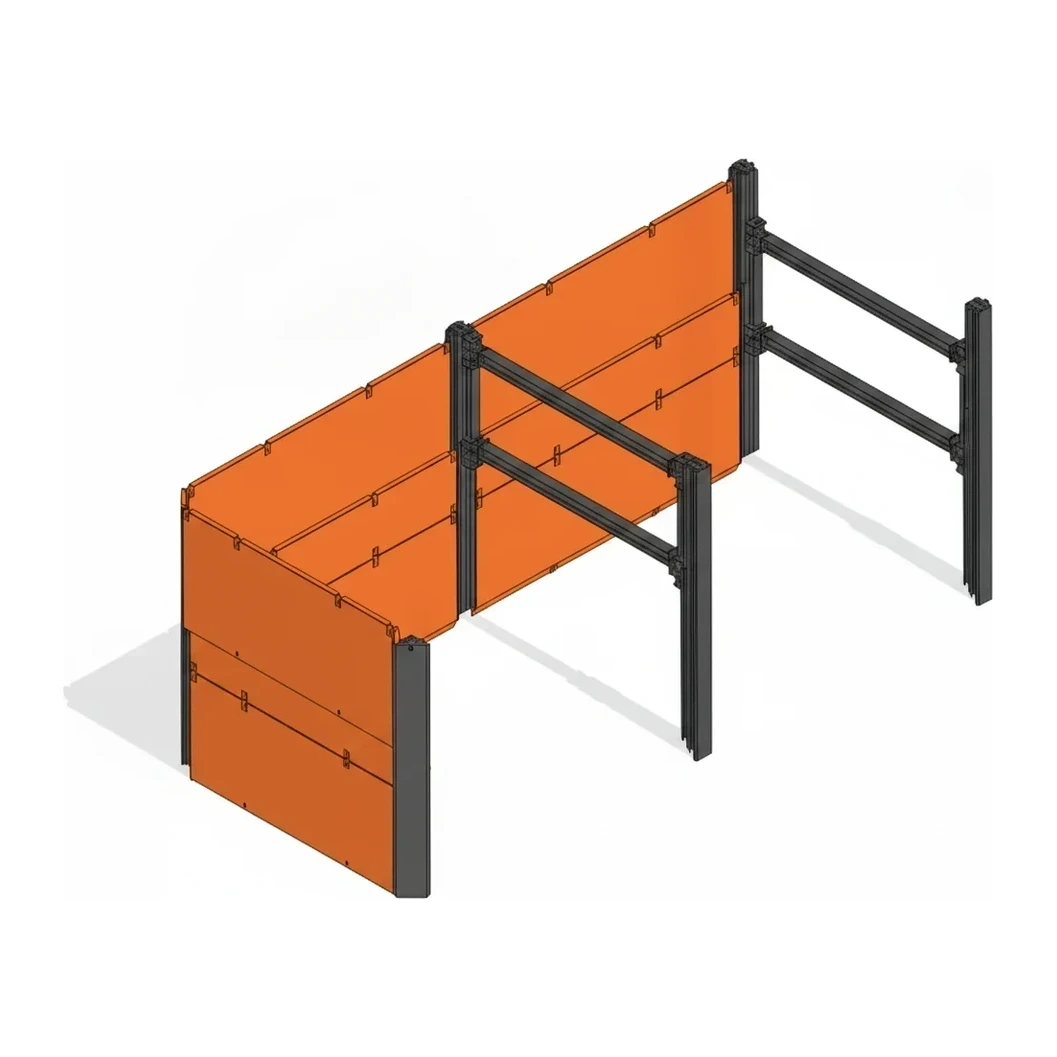
A slide rail system is a modular steel shoring system for deep or large excavations, built from vertical rail posts and panels that slide within them. Unlike a trench box that is set into a pre-cut trench, slide rail is installed 'dig-and-push': panels advance downward as the excavation deepens, keeping the ground supported at every stage. It suits pits, tank installations, and excavations too large or too deep for standard boxes.
Fonctionnement
Corner and intermediate posts are set at grade, and steel panels are dropped into the rail guides between them. As the excavator removes soil inside the footprint, crews push the panels and posts incrementally downward so the shoring always leads the dig. Multi-tier rails allow panels to be stacked as depth grows. Because the ground is supported continuously during advancement, slide rail can work in unstable soils and near existing structures with minimal ground movement. Removal reverses the sequence: panels are raised in lifts as the excavation is backfilled, maintaining support until the ground is restored.
Types et variantes
- Linear (trench) configuration
- Parallel rail-and-panel runs shore long utility trenches in poor soils.
- Pit configuration
- Four-sided cells create clear-span working pits for tanks, structures, and wet wells.
- Multi-bay systems
- Repeating cells extend along large footprints, sharing posts between bays.
- Clear-span / obstruction-free setups
- Spreader-free arrangements keep the working area open for deep structures and equipment placement.
Spécifications clés
| Spécification | Plage typique | Signification |
|---|---|---|
| Maximum shored depth (ft) | Model- and configuration-specific; set by the engineered tabulated data for the system | Determines whether the system can reach the design excavation depth in the given soil class. |
| Panel dimensions | Per manufacturer system; panels stack in tiers within the rails | Governs bay length and how the system modularizes around the excavation plan. |
| Allowable soil pressure rating | Stated in the manufacturer's tabulated data by soil type | The engineering basis that matches the system to site soil conditions. |
Comment l'industrie le dimensionne
Slide rail systems are sized from the excavation plan: depth, plan dimensions, and soil classification determine post length, panel tiers, and bay layout. The manufacturer's engineered tabulated data, or a site-specific design by a registered professional engineer, governs the configuration. Sizing is an engineering exercise, not an off-the-shelf pick.
Applications
- Deep pits for tanks, lift stations, and wet wells
- Large-footprint excavations in unstable or flowing soils
- Utility work adjacent to structures, roads, and railways where ground movement must be minimized
- Trench runs too deep or too long for standard trench boxes
- Excavations requiring clear internal working space
Sécurité et opération
- A competent person must classify soil and oversee installation, advancement, and removal.
- Never let the excavation advance ahead of the shoring; panels must lead the dig per the installation sequence.
- Workers enter only within the protected footprint; ladders or ramps within 25 ft of workers are required in trench configurations.
- Follow the engineered drawings exactly; substituting components voids the tabulated data.
Normes et certifications
- OSHA · 29 CFR 1926.652
- Protective systems are mandatory in excavations 5 ft and deeper; slide rail qualifies under manufacturer tabulated data or engineered design.
- OSHA · 29 CFR 1926 Subpart P App. B-D
- Soil classification and design references that the system configuration must satisfy.
- OSHA · 29 CFR 1926.650-651
- Competent-person requirements, access/egress, and daily inspection obligations for shored excavations.
Questions fréquentes
When is slide rail chosen over a trench box?
Does slide rail require engineering?
How is the system removed?
Équipements connexes
Parcourir par fabricant
Sources
Chaque spécification est vérifiée par rapport aux données publiées par le fabricant, avec la source liée pour référence.
Tous les modèles
14 modèles · Chaque spécification citée à la source