

Gas Portable Air Compressor
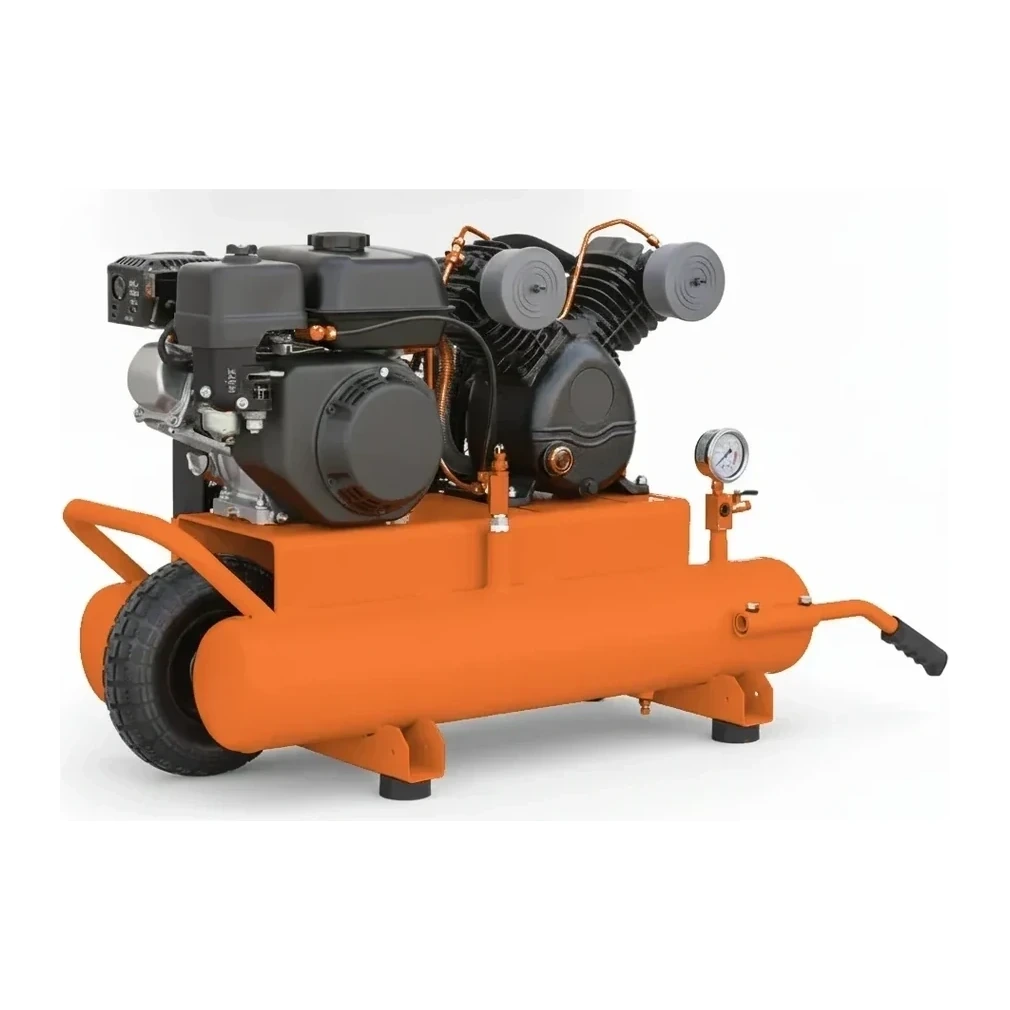
A gas portable air compressor pairs a gasoline engine with an air pump to deliver compressed air where no electrical hookup exists. The class runs from hand-carry and wheelbarrow-style units feeding one or two tools up to larger wheeled and towable machines supplying whole crews. Listed models deliver 4.2-400 cfm at maximum pressures of 100-175 psi.
Cat classes
Pick a size class: capacity and reach differ across the range.
How it works
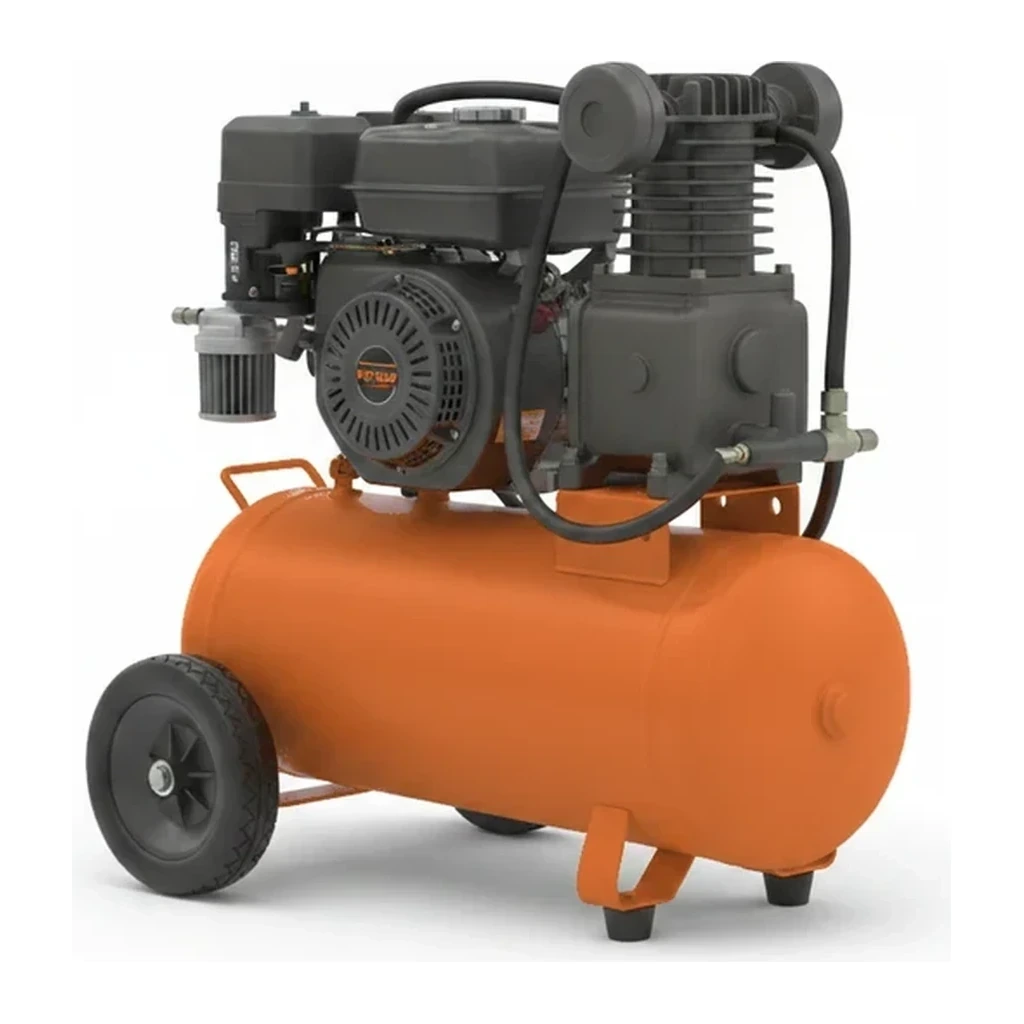
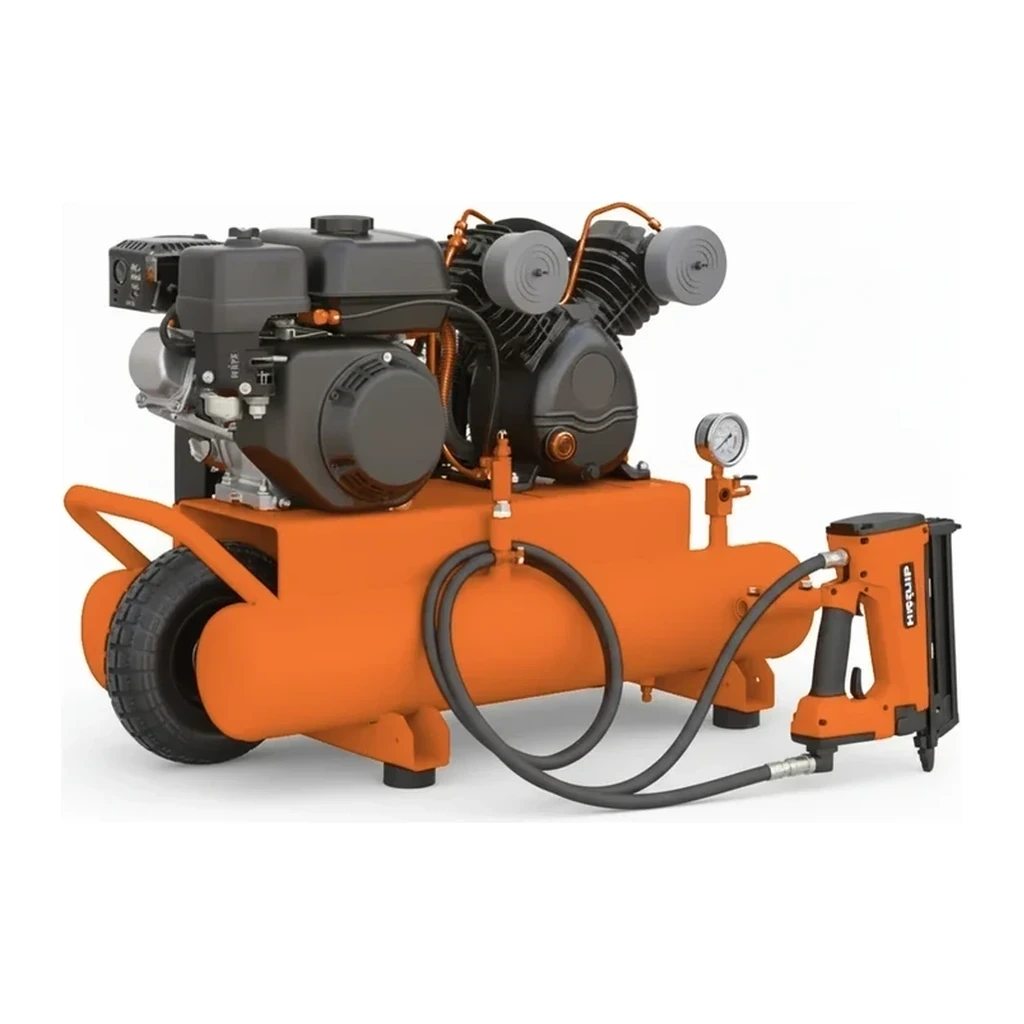
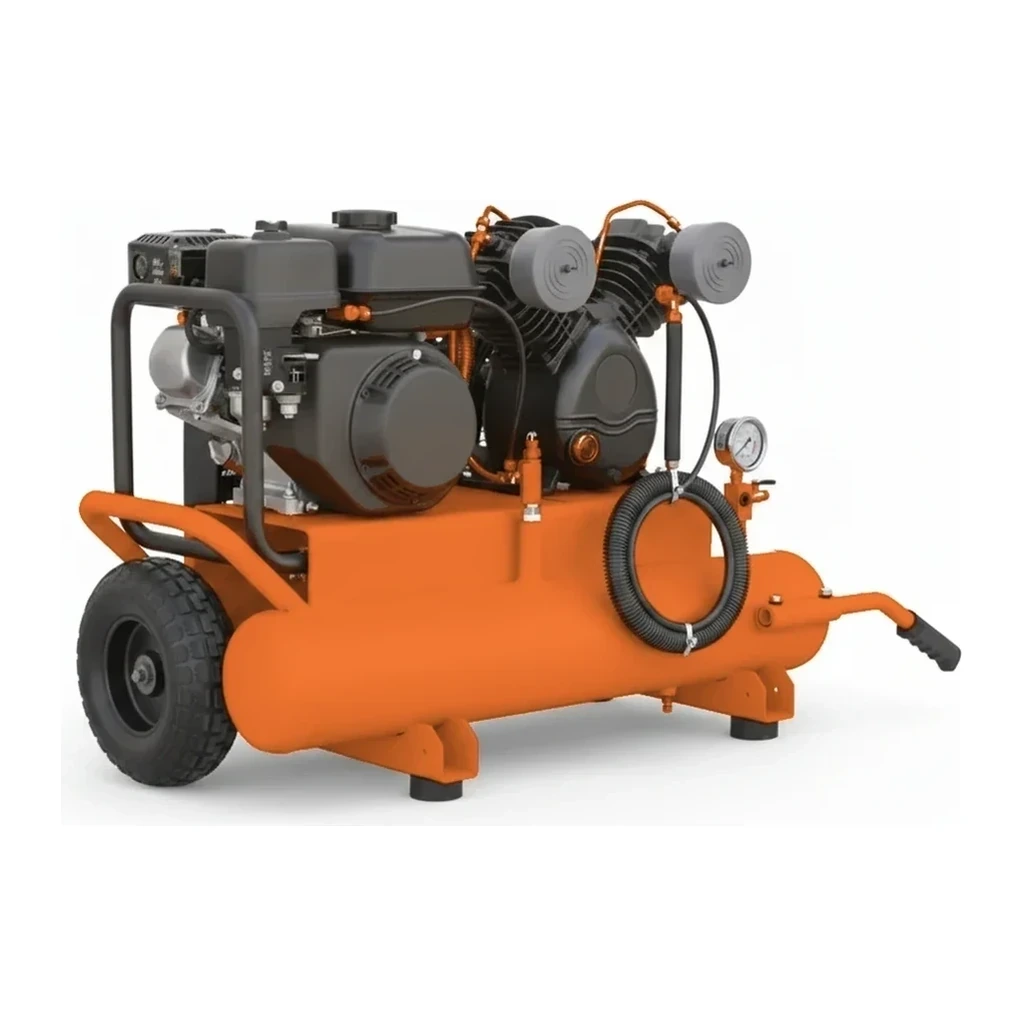
A gasoline engine—listed models report 4-302 hp on units publishing the spec—drives a piston pump or, on larger units, a rotary screw element. Compressed air accumulates in twin tanks or a receiver, and an unloader or throttle control idles the engine down when pressure reaches the set point, then loads it again as tools draw the pressure down. Delivered air, not tank size, is what runs a tool. Because the power source is onboard fuel, the unit is fully self-contained: listed fuel tanks hold 6-40 L, and pump lubrication is a routine check on multi-day work, with listed pump oil capacities of 0.5-1.8 L.
Types & variants
- Hand-carry and twin-tank units
- The smallest gas portables, with listed dry weights starting at 25 kg, built to feed one or two nailers or small tools.
- Wheelbarrow-style compressors
- Twin-cylinder pumps on a wheeled frame with lifting handles; the standard configuration for framing and roofing crews.
- Truck-mount units
- Compressors bolted into a service-truck bed to supply air for field maintenance and tire work.
- Towable gas compressors
- The top of the class, delivering up to the listed 400 cfm for multi-tool sites, sandblasting and remote work where diesel towables are oversized.
Key specifications
| Specification | Typical range | What it means |
|---|---|---|
| Free air delivery | 4.2-400 cfm across listed models | The primary sizing figure; the compressor's delivered air must meet the combined draw of every tool running at once. |
| Maximum pressure | 100-175 psi across listed models | The top of the working band; most pneumatic tools operate at 90 psi, so all listed units cover standard tool pressure. |
| Engine power | 4-302 hp on models reporting the spec | Sets recovery speed and how much continuous air the pump can make; larger engines hold pressure under heavier tool loads. |
| Fuel tank capacity | 6-40 L on models reporting the spec | Determines run time between refuels; sustained multi-tool loads drain the small end of the range quickly. |
| Dry weight | 25-145 kg across listed models | Determines portability and site-access options; the lightest units are hand-carried while heavier machines are wheeled or towable. |
How the industry sizes it
Gas portables are sized by cfm against the tool load. Up to 10 cfm handles one finish nailer or inflation work where there's no power. The 10-20 cfm band covers a framing nailer on a site with no power. The 20+ cfm band supplies one air tool running continuously, off-grid, or multi-tool loads including jackhammers and sandblasting. The governing check is delivered cfm at working pressure, not tank volume: a tool that draws more than the pump delivers will stall the work as pressure sags.
Applications
- Driving framing and roofing nailers on sites without power
- Running breakers and jackhammers where grid power is absent
- Sandblasting and surface preparation on remote structures
- Supplying air tools for road, pipeline and utility crews
- Field service and tire work from a truck-mounted unit
- Fence, deck and remote residential construction
Safety & operation
- Gasoline exhaust contains carbon monoxide; the compressor stays outdoors or in open air even when the hose is run inside to the work.
- Engine and pump surfaces run hot; units cool before refueling, and fuel is never added to a running engine.
- Hose couplings carry whip restraints, and connections are checked before the system is pressurized.
- Pump oil is checked on multi-day work; listed pump capacities of 0.5-1.8 L mean the smallest pumps need the most frequent checks.
- Receiver tanks are drained of condensate to prevent internal corrosion.
Standards & certifications
- OSHA · 29 CFR 1926.302(b)
- Pneumatic power tool and hose securing requirements on construction sites.
- OSHA · 29 CFR 1910.242(b)
- Limits compressed air used for cleaning to below 30 psi with chip guarding and personal protective equipment.
- ASME · Boiler and Pressure Vessel Code Section VIII
- Design standard for the receiver tanks fitted to gas portable compressors.
Frequently asked
What size gas compressor runs a single nailer?
Why does delivered cfm matter more than tank size?
Can a gas portable compressor run indoors?
How long does a tank of fuel last?
Compare popular models
Find by spec →Normalised to the same units. A dash means the figure was not published.
| Model | Free air delivery | Max pressure | Engine power |
|---|---|---|---|
| Multiquip GAC-36HZ | - | - | 8 hp |
| Multiquip AOX600 | - | - | - |
| Multiquip GAC-6HZ | - | - | 11 hp |
| Multiquip CA5BC | - | - | - |
| Multiquip CA5BM | - | - | - |
| Multiquip GAC-97HZ | - | - | 18 hp |
Related equipment
Browse by manufacturer
Sources
Every specification is verified against the manufacturer's published data, with the source linked for reference.