

Automated Flagger Assistance Device
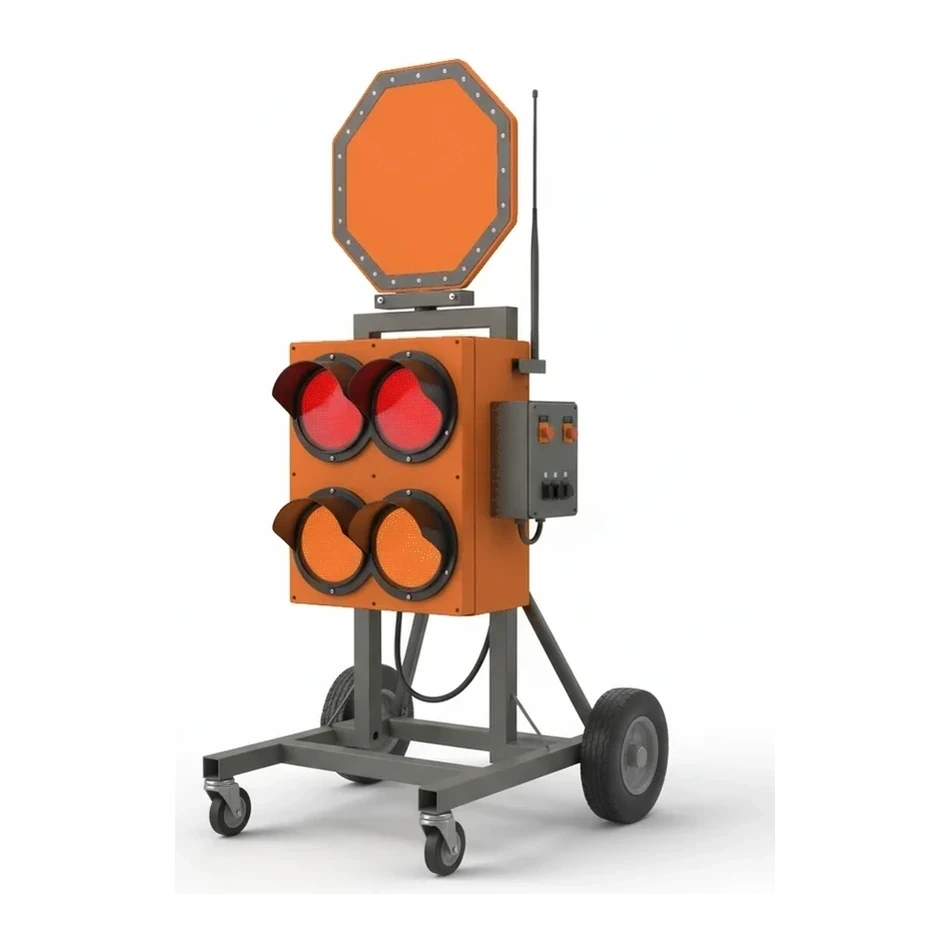
An Automated Flagger Assistance Device (AFAD) is a remotely operated traffic control system that displays stop/slow paddles to direct traffic through work zones. The device allows a single operator to control traffic flow from a protected location away from the roadway, reducing exposure to moving vehicles. AFADs serve as a supplement to traditional flagging operations in temporary traffic control applications.
How it works
The system consists of a mechanical arm or gate assembly mounted on a trailer or portable base that displays stop and slow paddles to oncoming traffic. An operator positioned at a safe distance from the travel lane uses a remote control or radio transmitter to activate the device, rotating the paddle assembly to show either the stop or slow face to approaching vehicles. The operator maintains visual contact with traffic conditions and coordinates the device with corresponding traffic control at the opposite end of the work zone. Most devices incorporate LED lights or reflective elements on the paddles to enhance visibility in low-light conditions. The trailer-mounted base provides stability and typically includes wheels for positioning and relocation. The operator station may include a shelter, two-way radio communication, and visual aids such as cameras or mirrors to monitor traffic conditions.
Types & variants
- Trailer-Mounted AFAD
- Self-contained unit on a towable trailer with integrated paddle assembly, power source, and stabilization system for roadside deployment
- Portable Base AFAD
- Lighter-weight system with detachable base designed for easier manual positioning in confined work zones
- Gate-Arm Style
- Configuration using a horizontal gate arm that extends across the lane with stop/slow paddle attached, providing physical lane closure indication
- Vertical Paddle Style
- Traditional flagging paddle mounted on a rotating vertical mast that pivots to display stop or slow face to traffic
Key specifications
| Specification | Typical range | What it means |
|---|---|---|
| Remote Control Range | Varies by model | Maximum distance between operator station and device for reliable signal transmission and visual monitoring |
| Paddle Diameter | 18 in (MUTCD standard) | Size of stop/slow sign face, typically matching MUTCD specifications for handheld paddles |
| Power Source | 12V battery or solar | Energy system for operating the paddle mechanism and LED illumination throughout shift duration |
| Visibility Distance | Varies by conditions | Effective sightline distance for approaching motorists to recognize and respond to displayed paddle |
How the industry sizes it
AFADs are not sized by capacity or dimensional variants. The industry primarily uses standardized paddle dimensions that comply with Manual on Uniform Traffic Control Devices (MUTCD) requirements for traffic control devices. Selection is based on deployment method (trailer-mounted versus portable), remote control range requirements, and power source preferences. The work zone configuration, traffic volume, and duration of the project determine the number of devices needed rather than specific size classes within the equipment type.
Applications
- Highway and roadway construction with single-lane closures requiring alternating traffic flow
- Bridge maintenance and repair operations with limited access and extended work zones
- Utility work in rural or high-speed corridors where operator safety is a primary concern
- Paving and resurfacing projects requiring mobile traffic control that relocates frequently
- Emergency roadway repairs in high-traffic areas where flagging personnel exposure must be minimized
- Long-duration work zones where traditional flagging creates fatigue and safety risks for personnel
Safety & operation
- Operator must maintain continuous visual contact with the device and approaching traffic to ensure appropriate paddle display
- Devices supplement but do not replace the need for qualified flagging personnel trained in traffic control procedures
- Advance warning signs and proper taper setup are required upstream of the AFAD location per MUTCD standards
- Regular testing of remote control communication and paddle rotation mechanism prevents operational failures during active use
- Backup communication systems and contingency plans must be established in case of device malfunction during traffic control operations
Standards & certifications
- MUTCD · Section 6E.07
- Establishes requirements for automated flagger assistance devices in temporary traffic control zones
- ATSSA
- American Traffic Safety Services Association issues best practices for AFAD deployment and operation
Frequently asked
How does an AFAD differ from traditional flagging operations?
What qualifications are required to operate an automated flagger assistance device?
Can one operator control multiple AFADs simultaneously?
What are the limitations on where AFADs can be deployed?
Related equipment
Browse by manufacturer
All models
1 models · Every spec cited to source