
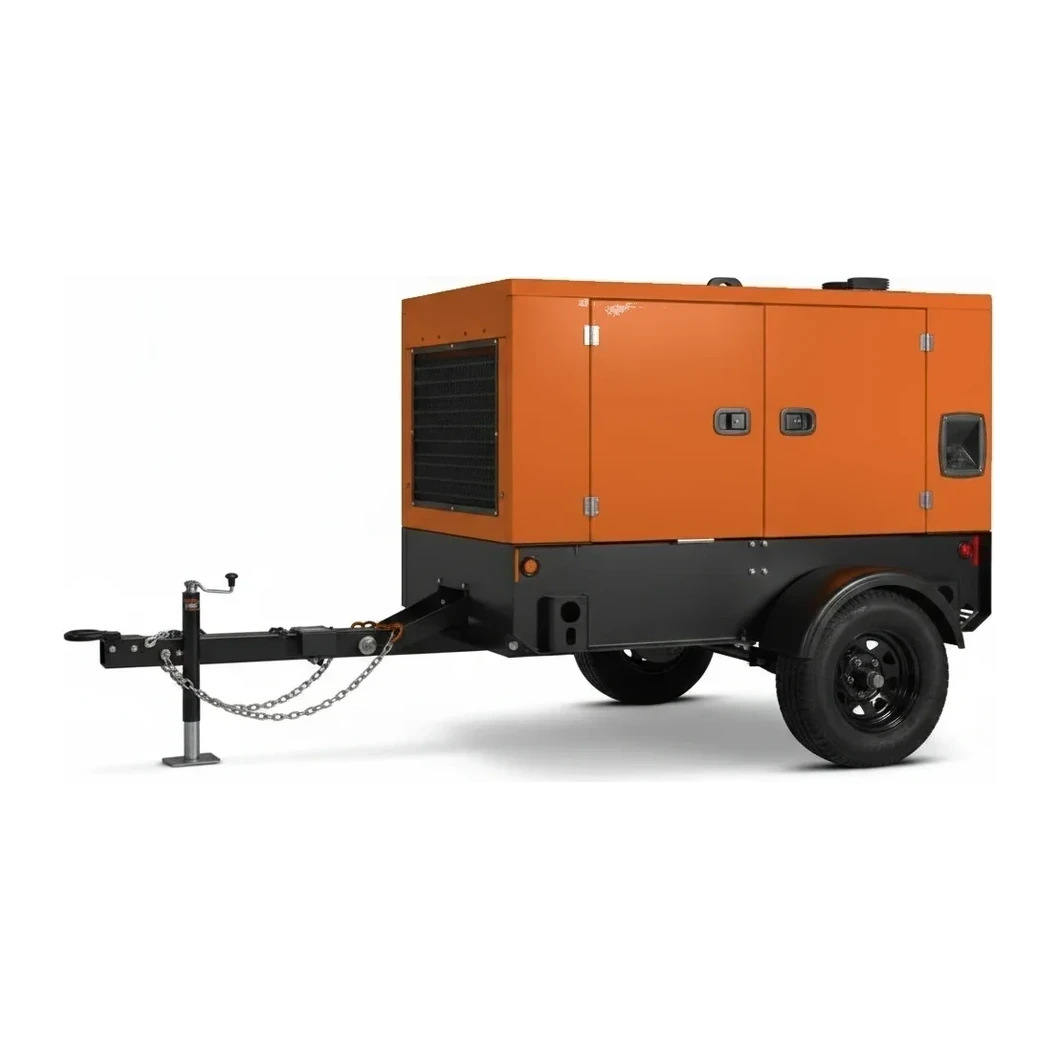
Towable Diesel Generator
A towable diesel generator is a trailer-mounted, self-contained electrical power generation unit equipped with a diesel engine, alternator, fuel tank, and control panel. These units deliver temporary, portable electrical power to construction sites, industrial facilities, and emergency backup applications where utility power is unavailable or inadequate. Configured for highway transport behind a standard pickup or truck, they range from compact units to multi-megawatt systems requiring flatbed transport.
Cat classes
Pick a size class — capacity and reach differ across the range.
How it works
The diesel engine drives a brushless alternator to convert mechanical energy into electrical power. The engine draws fuel from an integral tank, typically sized for 12 to 48 hours of runtime at full load, while an automatic voltage regulator maintains stable output voltage and frequency. Most units include a control panel with circuit breakers, outlets, and hour meters; many feature automatic start/stop capability and load-management controls. The trailer chassis provides structural support, weather protection, and road-legal towing hardware including axles, brakes, and lighting. Sound-attenuated enclosures reduce noise emissions, while integrated lifting eyes and forklift pockets facilitate positioning. Load bank testing and generator connection typically occur via twist-lock or cam-lock receptacles, with output configurations spanning 120/240V single-phase to 480V three-phase.
Types & variants
- Open-Frame Towable Generator
- Exposed engine and alternator mounted on a basic trailer chassis; lighter and more economical, used where noise and weather are secondary concerns.
- Sound-Attenuated Towable Generator
- Enclosed in a weather-resistant, sound-dampening canopy; standard for urban sites and residential areas where noise ordinances apply.
- Tier 4 Final Compliant Generator
- Equipped with modern diesel engines meeting EPA Tier 4 Final emissions standards through diesel particulate filters and selective catalytic reduction.
- Prime Power Generator
- Rated for continuous duty with unlimited run hours per year; heavier-duty components and larger cooling systems than standby-rated units.
- Paralleling Towable Generator
- Equipped with synchronizing controls and hardware to operate multiple units in parallel, enabling scalable power for large temporary loads.
Key specifications
| Specification | Typical range | What it means |
|---|---|---|
| Power Output (kVA) | 3.5–593.9 kVA | The continuous electrical output capacity, determining the maximum load the generator can support; the primary sizing metric. |
| Fuel Capacity | 1.6–275.0 gal | Onboard diesel fuel storage, determining runtime between refueling; larger tanks support extended unattended operation. |
| Rated Frequency | 60 Hz | The electrical output frequency; North American standard is 60 Hz, determining compatibility with connected equipment. |
| Rated Voltage | 120–480V | The electrical output voltage configuration; determines compatibility with site distribution equipment and connected loads. |
| Engine Displacement | 49.4–389.0 cm³ | The total swept volume of all engine cylinders, correlating with power output and fuel consumption characteristics. |
How the industry sizes it
The industry sizes towable diesel generators by continuous kilowatt (kW) output, the maximum electrical load the unit can sustain indefinitely. Common classifications include up to 25 kW for site trailers, light plants, or single pumps left for weeks; 25–60 kW for trailer complexes, multiple pumps, or small hoists; 60–150 kW for whole-site construction power including hoists, trailers, task lighting, and tools; 150–300 kW for building temporary service during utility cutovers or large process loads; 300–600 kW for hospitals, data centers, or plant turnarounds shipped on lowboys; 600–1,250 kW for utility-scale temporary power, usually paralleled and fed into distribution packages; and 1,250+ kW for plant-scale prime power and grid support with synchronized units. Standby ratings, expressed 10–15% higher than prime ratings, reflect short-duration peak capacity for emergency use. Load calculation includes the sum of all connected equipment plus a diversity factor accounting for simultaneous demand.
Applications
- Construction site power for temporary distribution panels, hoists, tools, and trailers before permanent utility service
- Industrial plant turnarounds and shutdowns requiring temporary power during equipment maintenance or upgrades
- Emergency backup power for hospitals, data centers, and critical facilities during utility outages or service transfers
- Event power for outdoor festivals, concerts, and sporting events lacking permanent electrical infrastructure
- Pipeline and well-site operations powering pumps, compressors, and process equipment in remote locations
- Disaster recovery and emergency response providing temporary power to damaged or off-grid areas
Safety & operation
- Maintain minimum clearances around the generator enclosure for cooling airflow and exhaust dispersal; carbon monoxide accumulation poses a lethal hazard in enclosed or poorly ventilated areas
- Verify ground fault protection and proper grounding of the generator frame and neutral conductor before energizing connected loads
- Confirm fuel and oil levels, coolant condition, and battery charge during pre-start inspection; monitor gauges during operation for overheating or low oil pressure
- Use listed load cables and connectors rated for the generator's output amperage; inspect for damage before each connection to prevent arc flash or electrocution
- Follow NFPA guidelines for diesel fuel storage and dispensing; maintain a fire extinguisher near the unit and prohibit smoking or open flames within 25 feet
Standards & certifications
- NFPA · NFPA 110: Standard for Emergency and Standby Power Systems
- Establishes installation, maintenance, and testing requirements for standby and emergency power systems including towable generators.
- EPA · Tier 4 Final Emissions Standards
- Federal regulations governing nitrogen oxide and particulate matter emissions from non-road diesel engines, phased in by horsepower class.
- OSHA · 29 CFR 1926.404
- Wiring design and protection requirements for temporary electrical installations on construction sites, including generator output protection.
Frequently asked
What is the difference between prime and standby power ratings?
How is generator size determined for a construction site?
What maintenance intervals apply to towable diesel generators?
What towing and transport requirements govern towable generators?
Compare popular models
Find by spec →Normalised to the same units. A dash means the figure was not published.
| Model | Power output | Fuel capacity |
|---|---|---|
| Multiquip GAW135H | 1.9 kVA | 1.6 gal |
| Generac MDG150DF4 | 120.0 kVA | - |
| Generac MGG210N2 | 185.0 kVA | - |
| Generac MDE330 | 264.0 kVA | - |
| Generac MGG450 | 360.0 kVA | - |
| Honda EU2200i Companion | - | 95.0 gal |
Related equipment
Browse by manufacturer
Sources
Every specification is verified against the manufacturer's published data, with the source linked for reference.
All models
114 models · Page 2 of 3 · Every spec cited to source